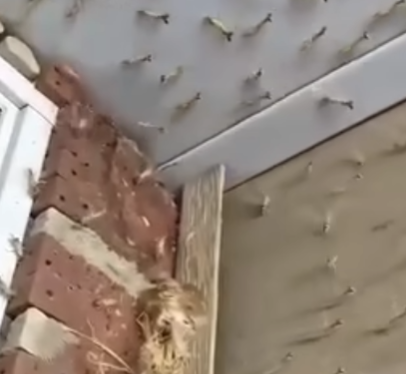
One quiet spring morning, I opened my front door expecting nothing more than cool air and birdsong. Instead, I stepped into one of the most fascinating natural events I’ve ever witnessed.
Scattered across my doorstep were dozens of tiny, delicate insects — pale green, threadlike, and no larger than my pinky finger. At first, I thought they were some type of ant swarm or newly emerged flies. But when I knelt down for a closer look, I recognized the unmistakable posture: folded forelegs held close to their bodies like hands in prayer.
They were baby praying mantises.
The brick wall beside my door seemed to shimmer with life. Some hatchlings clung to the vertical surface, perfectly still. Others moved cautiously toward nearby plants. A few paused as if adjusting to the brightness of the morning.
It was quiet. No dramatic sound, no visible rupture. Just dozens of tiny lives beginning all at once.
The Ootheca: Nature’s Protective Nursery
These hatchlings had emerged from an egg case known as an ootheca — a protective structure created by a female mantis after mating.
Praying mantises belong to the order Mantodea, a group of predatory insects with ancient evolutionary roots. The female produces a frothy secretion and deposits dozens — sometimes more than 100 — fertilized eggs into it. The foam quickly hardens into a durable, insulated casing.
The ootheca often resembles dried foam insulation or hardened packing material. It is typically attached to:
-
Tree branches
-
Shrub stems
-
Fence posts
-
Walls
-
Siding or brick surfaces
Apparently, one had been attached to my brick wall all winter — unnoticed, weathering cold temperatures and storms just inches from where I walked every day.
Inside, the eggs remained dormant through the colder months. When spring temperatures rose and conditions became favorable, the nymphs hatched nearly simultaneously, emerging through tiny openings and dispersing immediately.
Discovering that so much life had been quietly developing at my doorstep felt humbling.
The Early Moments of Life
Freshly hatched mantises are called nymphs. They look like miniature adults but lack wings and full coloration. Unlike butterflies or beetles, mantises do not undergo complete metamorphosis. Instead, they develop through gradual metamorphosis.
That means:
-
No pupal stage
-
No cocoon
-
No dramatic transformation
Instead, they grow by molting — shedding their exoskeleton multiple times as they increase in size. Each molt brings them closer to adulthood.
Watching them scatter was mesmerizing. Some climbed upward toward warmth and light. Others sought immediate shelter among leaves. A few remained motionless for long stretches, blending almost perfectly with the brick.
At this stage, they are incredibly vulnerable. Birds, ants, spiders — and even other mantises — pose threats. Cannibalism can occur if food is scarce.
Only a small fraction will survive to adulthood.
That made the sight of so many hatchlings feel even more extraordinary.
Built-In Predators From Birth
Even at this tiny size, their predatory traits were visible.
Praying mantises are instantly recognizable by their:
-
Enlarged, folded forelegs
-
Triangular heads
-
Prominent compound eyes
Their forelegs are equipped with sharp spines designed to snap shut and secure prey in milliseconds. Mantises are ambush predators. They do not chase relentlessly. They wait, perfectly still, until the moment is right.
Another remarkable feature is their head mobility. Unlike many insects, a mantis can rotate its head significantly, allowing it to scan its surroundings without moving its body. Combined with their large compound eyes, this gives them a wide field of vision and exceptional depth perception.
Even as nymphs, that awareness is evident.
The Role of Mantises in the Ecosystem
Praying mantises are considered beneficial insects in many gardens. They consume a wide range of prey, including:
-
Flies
-
Mosquitoes
-
Aphids
-
Moths
-
Caterpillars
-
Beetles
By feeding on these insects, they help regulate pest populations naturally.
Gardeners often welcome mantises because they reduce reliance on chemical pesticides. Their presence supports ecological balance through natural predator-prey dynamics.
However, mantises are generalist predators. They do not distinguish between “pests” and beneficial insects. They may consume pollinators such as bees and, in rare instances, even very small vertebrates like hummingbirds.
Still, in many environments, their overall ecological contribution is positive.
Seeing dozens of hatchlings dispersing into nearby shrubs felt like nature assigning guardians to the plants around my home.
Observing Without Interfering
If you ever encounter mantis hatchlings near your home, the best approach is simple: observe gently.
Avoid:
-
Handling them
-
Disturbing the ootheca
-
Using pesticides nearby
Providing natural vegetation — shrubs, tall grasses, flowering plants — offers them shelter and hunting grounds.
Over the next several weeks, surviving nymphs will molt repeatedly. By late summer, many will reach adulthood and develop wings.
Watching even part of that transformation can deepen your appreciation for insect life cycles.
Cultural Significance of the Praying Mantis
Beyond biology, praying mantises hold symbolic meaning in various cultures.
In Chinese tradition, the mantis represents patience and focused awareness. Its stillness before striking is often viewed as a metaphor for discipline and mindfulness.
In certain African cultural interpretations, mantises are associated with good fortune or spiritual presence.
Some Native American traditions describe the mantis as a symbol of quiet observation and intuition.
Across cultures, a common theme emerges: stillness combined with readiness.
The Science of Patience
From a biological perspective, mantises embody efficiency. Rather than expending energy chasing prey, they conserve energy and wait for opportunity.
This ambush strategy increases hunting success while minimizing risk.
Watching the hatchlings pause, adjust, and proceed cautiously felt like witnessing that principle in action.
Not everything in nature is loud or dramatic. Sometimes survival depends on stillness.
An Ancient Lineage
Mantises are not newcomers to Earth’s ecosystems. Fossil evidence suggests mantis-like insects have existed for tens of millions of years, adapting to shifting climates and habitats.
To witness a new generation emerging is to glimpse a continuation of an ancient evolutionary story.
And it happened right outside my front door.
Encouraging Biodiversity at Home
If you want to support beneficial insects like mantises:
-
Plant native vegetation
-
Reduce pesticide use
-
Leave small areas of natural growth undisturbed
-
Encourage insect diversity
Healthy ecosystems rely on balance. Even small backyard spaces can serve as important microhabitats.
A Morning I Won’t Forget
Within an hour, most of the tiny mantises had disappeared into surrounding greenery. The doorstep returned to normal.
But something felt different.
I had witnessed renewal — quiet, precise, and completely unspectacular by human standards. No announcement. No fanfare. Just life beginning.
The experience reminded me that extraordinary processes are unfolding constantly, often unnoticed.
Sometimes, all it takes is opening your front door at the right moment to see them.
And if we slow down long enough to notice, even the smallest creatures can teach us about resilience, balance, patience, and the enduring cycle of life.